Best online community platforms for organizations (2026)

There’s no single best online community platform – the right choice depends on what your community exists to do. An independent coach selling a video course needs a vastly different platform than a global professional association managing thousands of dues-paying members, for example.

Choosing the right community platform means understanding what each one is built to do. To help you navigate the options and find the right fit for your organization’s needs, we’ve rounded up the top online community platforms in 2026, including our own.

Quick answer: which platform is best for your organization?

The best online community platform for your organization depends on the type of work you do. Hivebrite is the best choice for communities with complex or dynamic structures like alumni networks, associations, and corporate programs. Alternative platforms like Circle are better suited for individual creators and small coaching businesses.

If you’re evaluating software for an organization, your decision usually falls into one of a handful of categories:

  • Alumni & higher education: Hivebrite
  • Associations: Hivebrite or Higher Logic
  • Customer support & product feedback: Bettermode, Gainsight or Discourse
  • Developer hubs: Discourse or Discord
  • Corporate communities: Hivebrite
  • Independent creators: Circle, Skool, or Mighty Networks
  • Nonprofits & chapter networks: Hivebrite or Circle

How we evaluated these platforms

We assessed the top platforms on the market based on the realities of running a complex organization. Specifically, we looked at a set of organizational requirements, including:

  • Data governance and security: Does it pass IT and compliance reviews?
  • Integrations: Does it connect bidirectionally with major CRMs and Association Management Systems (like Salesforce)?
  • Role-based permissions: Can it handle complex, multi-tiered access for staff, volunteer leaders, and regular members?
  • Architecture: Can it support a centralized hub as well as federated local chapters?
  • Branding: Does the platform look and feel like your brand, or does it force your members into a third-party interface?

What we didn’t consider: We didn’t factor in creator monetization features, tipping, or social audience-building features. If your main goal is selling a standalone digital product to your audience, the criteria we used in this guide will be less useful to you.

The top online community platforms in 2026

Here are the top community platforms on the market right now, what they do best, and where they fall short.

Hivebrite

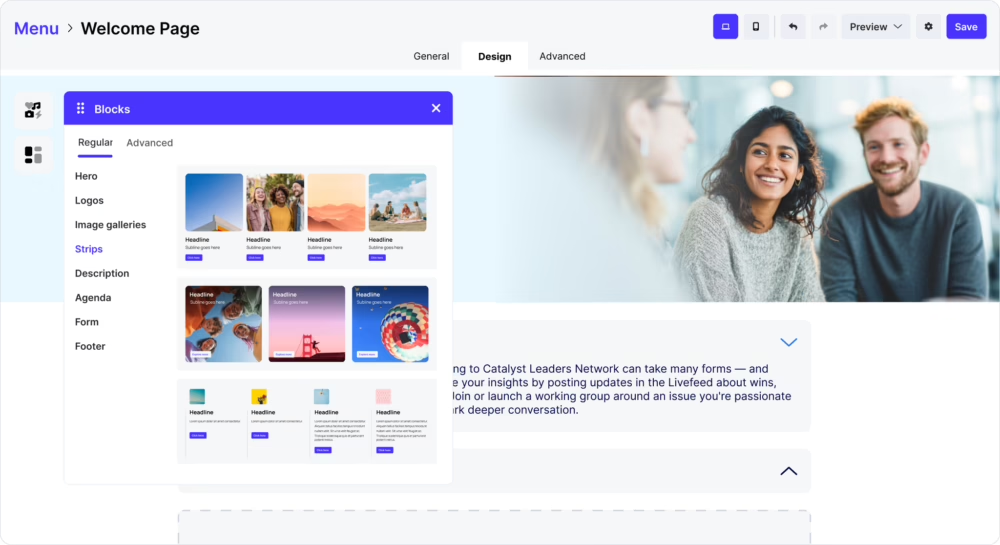
Hivebrite is a flexible, intelligent community platform built for complex organizations. You can run global networks, local chapters, and tiered memberships from one platform, all navigated through a clean and modern UI. It brings together an interactive member directory, event management, fundraising, discussion forums, AI agents, automations, WhatsApp and MCP to bring your community directly to your members, and a white-label mobile app.

  • Best for: Alumni networks, associations, nonprofits, and corporate communities.
  • Strengths: Robust data governance and compliance controls, CRM and AMS integrations, a customizable native mobile app, and group and chapter management.
  • Limitations: Some configuration and onboarding time. Overpowered for solo creators or small hobby groups.
  • Fit for organizations: The right fit for organizations that can’t compromise on data security or membership complexity.

Circle

Circle is a user-friendly platform designed for creators, coaches, and digital brands. It merges discussions, live streams, and courses into a clean, modern interface organized by “spaces”.

  • Best for: Digital creators, coaches, and small subscription businesses.
  • Strengths: Attractive, intuitive user interface; excellent native course-builder; direct paywall integrations for monetizing access.
  • Limitations: Lacks the data governance, AMS integrations, and complex architecture required by large institutions.
  • Fit for organizations: A great fit for a small company running a simple customer training group, but won’t meet the needs of a heavily regulated organization.

Mighty Networks

Mighty Networks focuses on allowing creators to build communities by combining discussion feeds, courses, and commerce, with a strong emphasis on mobile access.

  • Best for: Course-led communities and independent entrepreneurs.
  • Strengths: Combines course hosting, paid memberships, and community chats into one easy-to-use platform; highly visual, dynamic activity feed.
  • Limitations: Geared toward monetization and individuals selling digital products, making the feature set less useful for traditional organizations.
  • Fit for organizations: Great for independent educators not best suited for organizations looking for a robust platform built for scale and complexity.

Higher Logic

Higher Logic is a legacy community platform with deep roots in the professional association space. It focuses on discussion forums and automated email campaigns.

  • Best for: Traditional trade and professional associations.
  • Strengths: Deep integrations with legacy Association Management Systems (AMS); powerful automated email logic.
  • Limitations: The user interface feels dated compared to modern alternatives, and setup can be complex.
  • Fit for organizations: A historically safe choice for associations. However, it’s been slow to integrate modern AI and automation features, prompting some to migrate to faster-moving platforms with fresher interfaces.

Bettermode

Bettermode is a customizable community platform designed to embed directly into a company’s existing website or product using a block-based builder.

  • Best for: Customer support communities and B2B software companies.
  • Strengths: Clever building-block design lets you drop community features directly into your own app or site; great templates for ideation and Q&A.
  • Limitations: Not enterprise-ready. Lacks native analytics and automations—requiring third-party API or Zapier connections—and leans heavily toward brand feedback rather than true peer networking.
  • Fit for organizations: Excellent for software companies wanting to build a public help center, but less suited for networking-first organizations.

Discourse

Discourse is open-source forum software. It modernized the classic message board format and is widely used for technical support and developer communities.

  • Best for: Open-source projects, gaming communities, and developer hubs.
  • Strengths: World-class text editing, robust moderation features, and technically free if you host it yourself.
  • Limitations: It’s strictly a forum. It lacks event management, membership directories, and native chapter architecture.
  • Fit for organizations: A great basic solution for IT support, but too limited to serve as an organization’s primary community hub.

Discord / Slack

These are real-time chat applications — Discord built for gaming communities, Slack for workplace teams — that many organizations use as a community substitute.

  • Best for: Real-time team collaboration or casual, high-frequency chat.
  • Strengths: Members already have the apps installed; immediate, high-velocity engagement.
  • Limitations: At scale, real-time chat becomes difficult to navigate. Threads move fast and institutional knowledge gets buried.
  • Fit for organizations: Good for quick internal chats, but ultimately just a messaging tool, not a comprehensive community solution. It’s unsuited for hosting discussion forums, building searchable knowledge bases, or collaborating on long-term projects.

Skool

Skool is a stripped-down, highly gamified platform that combines a community feed, a course builder, and a calendar into one extremely simple interface.

  • Best for: Sales funnels, coaching programs, and influencers.
  • Strengths: Simple interface, flat pricing model, and built-in leaderboards that gamify participation.
  • Limitations: Very rigid. You can’t customize the layout, there are no complex permission tiers, and it lacks organizational security controls.
  • Fit for organizations: Unsuitable for large organizations, but highly effective for a solo coach.

Platform Comparison

Platform Best for… CRM / AMS Integrations Enterprise Security (SSO & GDPR) Chapter Management Custom Branding Target Audience
Hivebrite Complex organizations Advanced / Custom Yes (Native SSO & GDPR) Yes Yes Orgs, Associations, Alumni, Nonprofits
Circle Creators & Coaches Basic (Zapier) Partial (SSO on premium tiers) No Partial Individual Creators
Mighty Networks Course Builders Basic (Zapier) Partial (SSO on premium tiers) No Partial Entrepreneurs
Higher Logic Legacy Associations Advanced Yes Yes Yes Associations
Bettermode Customer Support Moderate Yes No Yes B2B Software Companies
Discourse Technical Forums Moderate (API) Yes No Partial Developers & Gamers
Discord / Slack Real-time Chat Basic Yes (Slack) / No SSO (Discord) No No Teams & Casual Groups
Skool Coaching Funnels Basic (Zapier) No SSO No No Solo Coaches

Choosing by organization type

How your organization operates will determine which online community platform is best for you. Here’s how to choose based on your organization type.

Higher education

Best platform: Hivebrite

University networks need secure, searchable directories, formal mentorship programs, and local regional chapters. Hivebrite is built for this, allowing universities to manage global alumni data securely while helping members connect in their own cities.

Developer hubs

Best platform: Discourse or Discord

Technical communities and open-source projects don’t need event or chapter management. They need specialized text editing, code-snippet support, and deep moderation controls. Discourse is the leader in this space, with a customizable, open-source forum environment that developers already know and trust.

Associations

Best platform: Hivebrite or Higher Logic

Associations run on dues. Their platform must connect reliably with their association management system to ensure only paying members access gated resources. Both Hivebrite and Higher Logic handle these kinds of deep integrations.

Nonprofits & chapter networks

Best platform: Hivebrite or Circle

Global nonprofits rely on a central headquarters coordinating hundreds of federated chapters. Hivebrite lets you connect multiple networks under one global umbrella. Local leaders can run their own groups, while headquarters keeps an eye on the big picture. A small, single-location charity might find everything they need in a lightweight platform like Circle.

B2B customer support

Best platform: Bettermode or Discourse

If your main goal is reducing support tickets and collecting product feature requests, you need software built for ideation and ticketing. Bettermode excels here. Its building-block platform lets software companies embed help centers and feedback boards directly into their own products, making it a better fit than networking-first platforms for this use case.

Corporate alumni & ERG programs

Best platform: Hivebrite

Corporate programs demand rigorous security, single sign-on, and data compliance controls. Hivebrite passes corporate IT and security reviews while providing the networking features necessary to run employee resource groups and corporate alumni networks safely.

Do you need a platform at all? Slack, Discord, Discourse, and building your own

Many organizations try to save money by falling back on free chat applications like Slack or Discord, launching an open-source forum like Discourse, or having their IT team build a custom portal from scratch.

When does a simple, standalone app make sense? When you only need a quick way for a ten-person committee to share files, Slack is perfect. When you want a public message board for developers to log bug reports, Discourse works beautifully.

But relying on these platforms to host your main organization community is a mistake. Chat apps don’t preserve institutional knowledge. Answers get buried within days, and new members can’t find what’s already been discussed.

Building your own platform creates a different set of problems. Organizations often underestimate the hidden, ongoing costs of maintaining software. By building your own site you’re committing to ongoing security patching, server hosting, and native mobile app maintenance. If the internal developer or community manager who led the custom build leaves, the platform becomes difficult to maintain.

A purpose-built platform ensures your system evolves, stays secure, and remains fully supported regardless of internal staff turnover.

What community platforms cost

Community pricing varies a lot based on the target audience. Platforms built for solo creators charge flat monthly fees, while platforms built for organizations offer flexible prices based on database size, security requirements, and integration complexity.

Platform Pricing Band Model
Hivebrite From $895 / month Custom pricing based on network size and specific modules.
Circle $89 – $399+ / month Tiered pricing based on features and member limits.
Mighty Networks $79 – $359+ / month Tiered pricing; separate tier for mobile apps.
Higher Logic Custom Custom pricing based on AMS integration and user volume.
Bettermode $399 – $1,500+ / month Tiered subscription model scaling based on active users and premium integrations.
Discourse Free – $500+ / month Free if self-hosted; tiered pricing for managed hosting.
Discord / Slack Free – $18+ per user / month Free tiers available; Slack charges per seat for premium features.
Skool $99 / month Flat monthly fee for one group; unlimited members.

Frequently asked questions

Hivebrite is the top choice for complex organizations, alumni networks, and associations. Bettermode excels at B2B customer support, Discourse is the standard for developer forums, and Circle and Skool are strong choices for individual creators selling courses.

The most basic creator platforms cost between $50 and $100 a month. Platforms for organizations run from several hundred to several thousand dollars a month, depending on database size, security needs, and custom integrations.


Slack and Discord are real-time chat applications designed for live conversation. A community platform organizes information into permanent, searchable structures like forums, directories, and resource centers.

For most organizations, no. Building your own means taking on permanent costs — security patching, mobile app updates, server maintenance — and the platform becomes fragile when the people who built it move on.

Platforms built for organizations. Hivebrite offers services with bidirectional integrations for major CRMs like Salesforce, Hubspot, and leading association management systems.

Hivebrite. It provides the architectural flexibility required to manage global directories, local alumni chapters, and dedicated mentorship programs securely.

Hivebrite is the top choice, combining the deep AMS integrations and gated content controls that dues-paying associations require with a modern user experience. Higher Logic serves as a legacy alternative for organizations heavily tied to older systems.

For a casual hobby group, a free platform is often enough. If you represent an organization, probably not. Free platforms offer limited data ownership, lack security controls, and offer no branding options.